
In today’s data-driven world, organizations across industries are facing a fundamental shift: the rise of AI agents versus traditional business intelligence (BI) tools. Almost every executive wants analytics that delivers not just answers, but actionable insights that drive better decisions faster. This is highlighted in a recent McKinsey study, where more than 60% of organizations are already experimenting with agentic AI. Yet many teams still rely on legacy BI stacks built for static dashboards and manual querying — systems that struggle with complexity, real-time insights, and the pace of modern business. It’s for this reason that over 60% of enterprises have yet to move from the experimentation stage and scale AI across their organizations.
This article explains the differences between AI agents and traditional BI, highlights where each shines or falls short, and shares practical guidance for teams navigating this transition.
What Are AI Agents in Business Intelligence?
At its core, an AI agent is a software entity that can interpret questions, analyze data, and take intelligent action autonomously or with minimal human input. When applied to business intelligence, these agents go far beyond static dashboards and reports; they can reason over data, speak natural language, trigger workflows, and even detect anomalies proactively.
In contrast to traditional BI tools — which require analysts to write queries, build visualizations, and interpret outcomes — AI agents can automate analysis, explain results, and generate insights without manual intervention. This capability comes from integrating large language models (LLMs), machine learning, and natural language processing directly into the analytics layer.
How AI Agents Work
An AI agent in BI typically performs several key tasks:
- Understand questions posed in natural language with the ability to adjust to the business context and every-day language of the user.
- Break complex queries into logical steps that are easily explainable and traceable.
- Retrieve data and apply analytical reasoning based on the specific task/s dictated by the user.
- Surface predictive analytics and proactive insights in order to forecast trends and help the user to understand what is likely to happen next.
- Recommend next steps or actions either via suggestions delivered to the user or, if permitted, perform them autonomously within specific parameters and guard rails.
For example, instead of asking a dashboard to “show sales by region,” a user might ask an AI agent, “Why did revenue drop in EMEA last quarter?” The agent then autonomously analyzes patterns, identifies correlations, and delivers an explanation — often within seconds.
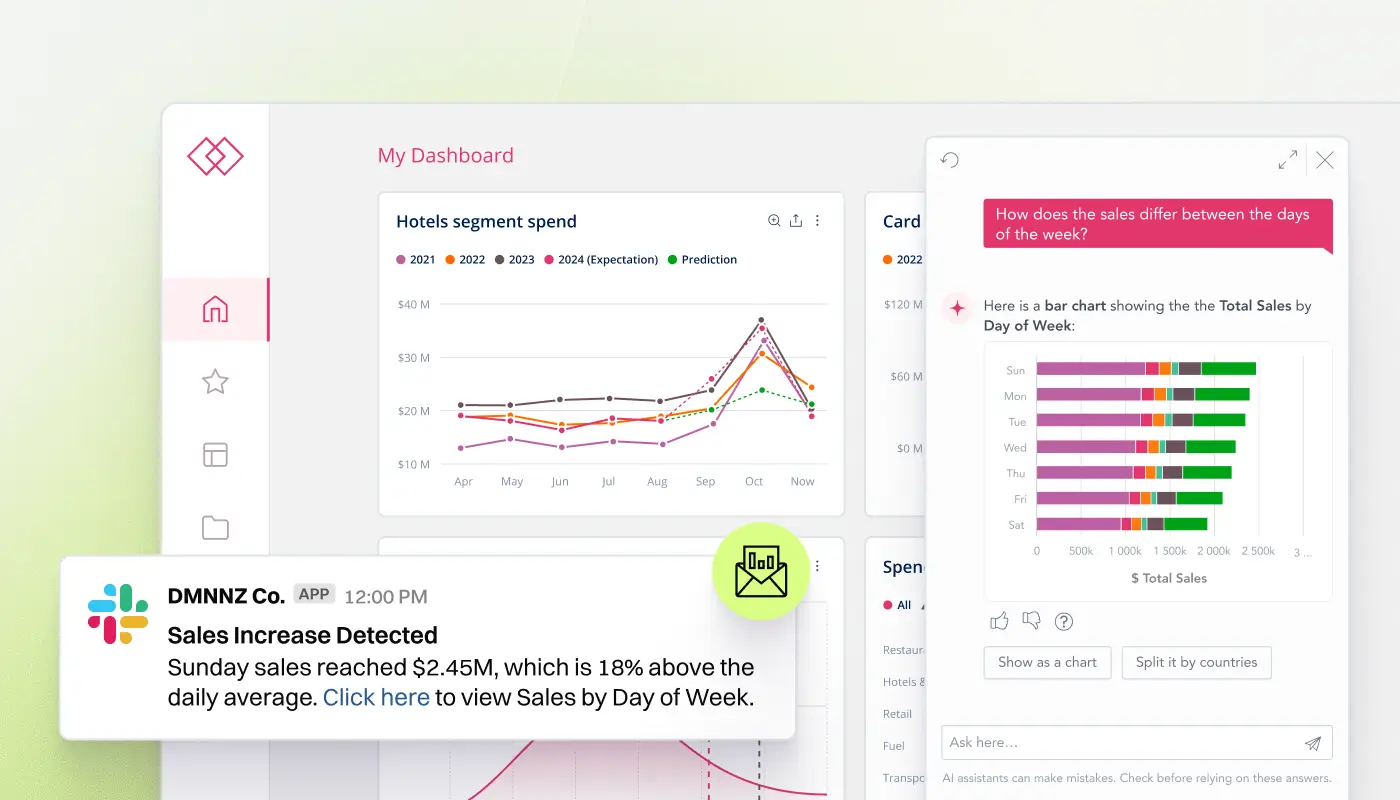
An example of an AI agent delivering suggested actions to the user.
What Is Traditional Business Intelligence?
Traditional BI refers to the established tools and processes used to collect, analyze, and visualize data to support business decisions. This includes data warehouses, dashboards, SQL queries, and reporting tools that have been the backbone of enterprise analytics for years.
These systems are powerful for structured reporting and visualization. However, they rely heavily on manual input — meaning users often have to know how to write queries, interpret dashboards, and build reports tailored to each question. Insights are often reactive and static, updated at scheduled intervals rather than continuously.
Limitations of Traditional BI
While traditional BI has enabled data-driven decision-making for decades, it faces several challenges in today’s fast-moving landscape:
- Manual query dependency: Users must know how to write SQL or configure dashboards
- Slow time-to-insight: Updates usually occur in batches rather than in real time.
- Limited real-time insights: Dashboards aren’t always live, and exploring data on demand can be slow.
- Poor data democratization: Insights often remain accessible only to trained analysts or require BI team involvment.
- Static insights: Reports reflect historical data, not future predictions or actionable recommendations.
These traditional BI limitations have prompted many teams to seek more intelligent, adaptive alternatives.
AI Agents vs Traditional BI: A Structured Comparison
To understand the core differences, the table below highlights how each approach tackles key analytics capabilities:
| Capability | Traditional BI | AI Agents |
|---|---|---|
| Query Method | Manual SQL & dashboards | Natural language & reasoning |
| Insight Generation | Predefined & static | Continuous & autonomous |
| Real-Time Insights | Limited | Native |
| Data democratization | Low | High |
| Predictive analytics | Add-on or separate tool | Built-in |
| Proactive insights | ❌ | ✅ |
| Ease of use | Analyst-dependent | Conversational and intuitive |
This side-by-side table clarifies the contrast in agentic BI vs traditional BI.
Why Are AI Agents Better Than Traditional BI Tools?
The short answer is that AI agents overcome many of the core traditional BI challenges by automating analysis and making analytics accessible to more users. Further reasons include:
Faster Time to Insight
AI agents continuously analyze data and are capable of real-time responses to queries. Traditional BI tools may only update periodically, meaning insights arrive hours or even days after events unfold.
Improved Decision Quality
AI agents do more than surface data — they help interpret it. By applying predictive analytics and intelligent reasoning, they can highlight root causes and future risks.
Enhanced Accessibility
With natural language interfaces, non-technical users can ask complex questions without needing SQL or BI tool proficiency. This level of data democratization empowers teams across departments to make data-backed decisions.
Actionable Recommendations
The most advanced AI agents go beyond reporting: they can suggest or even trigger actions based on insights — making BI more decision-oriented and less exploratory.
How Do AI Agents Improve Business Intelligence in Practice?
When compared to traditional BI, AI agents have the ability to enhance specific analytics workflows, which have the following benefits:
Improving Forecasting Accuracy
Traditional BI typically relies on predefined models and periodic data updates, which can lag behind business changes. AI agents incorporate machine learning to adapt predictions as new data arrives, improving forecasting accuracy and relevance.
Eliminating Analytics Backlogs
Analytics teams often face long queues of data requests. By autonomously handling routine analysis and insight generation, AI agents reduce backlog and free analysts for deeper, strategic work.
Contextualized Understanding
AI agents utilize semantic layers and natural language processing to understand the meaning behind terms, metrics, and business logic. This reduces ambiguity and aligns outputs with business context.
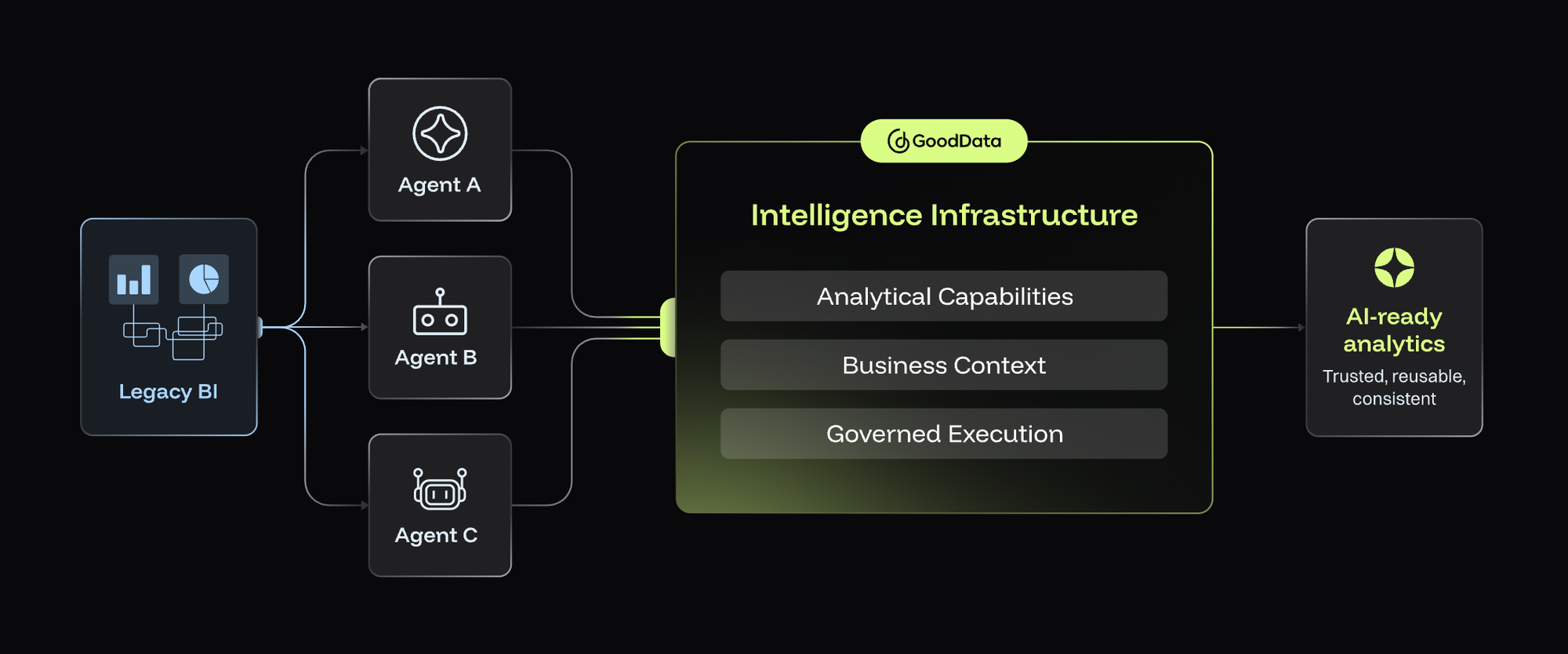
How GoodData provides the foundation for agentic analytics.
Can AI Agents Replace Traditional BI Systems?
A common question is: “Can AI agents replace traditional BI systems altogether?” The realistic answer is yes and no.
AI agents extend and enhance traditional BI platforms — often integrating with existing systems like Snowflake, Power BI, or embedded dashboards — rather than replacing them outright. Modern analytics environments benefit from a hybrid approach:
- Traditional BI continues to provide robust governance, visualization, and compliance workflows.
- AI agents automate analysis, enable conversational questions, and deliver proactive insights.
In this sense, AI agents don’t make BI obsolete — they evolve it into something more adaptive, intelligent, and user-friendly.
Next-Generation Business Intelligence: The Role of AI
The future of analytics is unfolding toward autonomous, AI-powered systems that combine the best of traditional BI with intelligent automation. These systems:
- Support conversational AI for BI, letting users ask questions in natural language.
- Leverage predictive analytics and machine learning to foresee trends.
- Enable self-service analytics without bottlenecks.
By blending deterministic BI processes with AI agents’ reasoning capabilities, organizations can build a proactive analytics environment that powers faster decisions.
How To Get Started With AI Agents in BI
Transitioning from traditional BI to AI agents doesn’t happen overnight, but a strategic roadmap can accelerate adoption:
1. Start With Business Problems
Focus on high-value questions your organization needs answered. For example, “Why did revenue drop in a key market this quarter?” defines scope and purpose.
2. Build a Strong Data Foundation
Ensure data is centralized, governed, and accessible. This includes reliable data warehouses and clear definitions for metrics.
3. Pilot With Targeted Use Cases
Run AI agent pilots in controlled environments. Validate results with key users and refine models before enterprise-wide rollout.
4. Integrate With Existing Tools
AI agents should augment, not replace, your BI ecosystem. Integrating an AI-ready tool like GoodData enables you to lay the proper foundations for agentic AI, and improves rather than replaces your existing BI stack. This makes integration with traditional BI tools like Power BI and Tableau an important feature, where the AI-ready tool brings a semantic layer to ensure trust, continuity, and governance.
5. Scale With Governance and Oversight
As adoption grows, embed governance policies — including auditing, compliance, and accountability — to maintain trust and reliability.
The Future of Business Intelligence Depends on AI Agents
The debate between AI agents vs traditional BI is not just academic — it’s shaping how organizations make decisions in 2025 and beyond. Traditional BI remains foundational, but AI agents are ushering in a new era of proactive, autonomous, and accessible analytics.
By embracing AI-powered business intelligence, companies can accelerate insights, reduce analytics backlogs, and empower users across the enterprise. The future of BI isn’t just faster dashboards — it’s intelligent analytics that thinks, reasons, and acts.
To see GoodData in action and understand more about switching from traditional BI to agentic analytics, request a demo.
Frequently Asked Questions about AI Agents vs Traditional BI
AI agents automate data analysis, reason through questions, and deliver proactive insights using natural language and machine learning, while traditional BI tools focus on dashboards, manual querying, and static reporting.
AI agents improve BI by enabling automated analysis, real-time insights, predictive forecasting, and data democratization — reducing reliance on analysts and speeding decision-making.
Because they automate complex analytics tasks, work with natural language, and deliver actionable insights autonomously — freeing users from manual reporting and static dashboards.
AI agents complement dashboards by delivering proactive insights and conversational analysis, but traditional BI visualizations remain valuable for governance and reporting.
Not entirely — traditional BI still provides structured visualization and governance. However, its role is evolving as AI agents take on continuous, real-time analytics.